
Ingredients: Behind the lens with roller derby filmmaker Courtney Montour
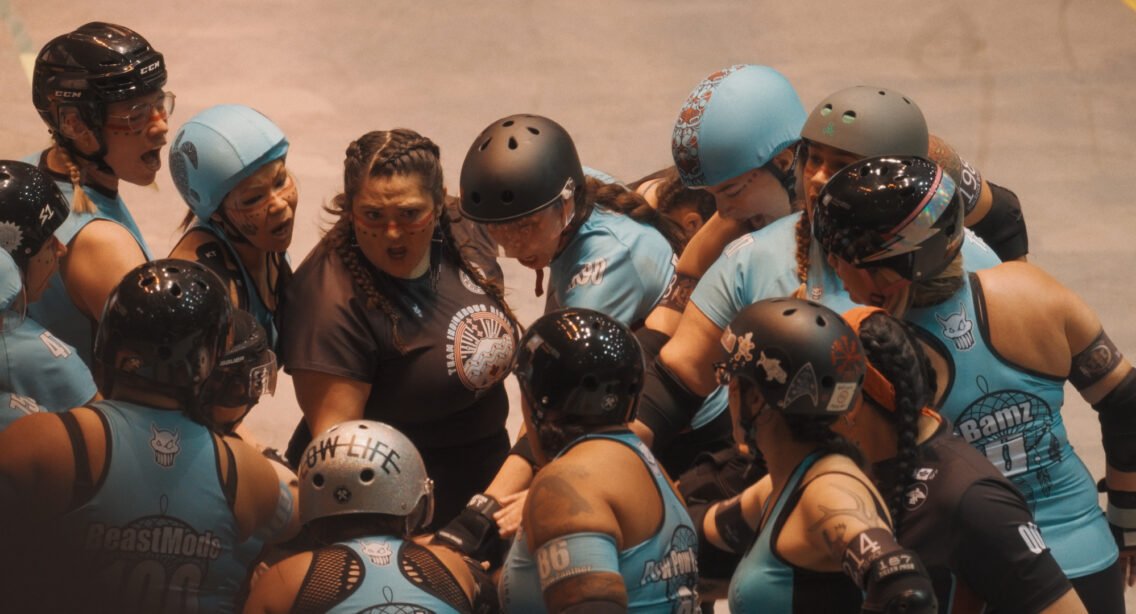
Courtney Montour (Kahnawà:ke) is the director and writer of the new film “Rising Through the Fray,” which follows a roller derby team calling themselves Indigenous Rising. Montour has been working with the team for years to bring the story to screen. Now, “Fray” is making its theatrical and festival debut across Canada and the United States with multiple screenings at upcoming festivals and theaters.
By Aminah Syed, Fry Bread Creative Digital Storytelling Intern
Fry Bread talked with Montour about the production and content of the film.
FRY BREAD: What got you super interested in making an entire film about rollerblading and especially in the Native American scene?
Montour: I’ve been a roller derby fan for probably as long as it’s been a modern day sport. I’ve had the opportunity to watch it for many years. I’d say I’m a super fan, and it’s just a really incredible community space. Very diverse, very welcoming, and really a queer community. That’s what drew me into watching the sport. And then also roller derby is a women’s sport, and it’s amazing to see that strength on the track. Roller derby is a highly competitive, full-contact sport, and you have two teams on the track, with one person trying to get through on each team to make the points. It’s just unbelievably athletic.
With “Rising Through the Fray,” what drew me to making a film is the creation of Indigenous Rising. They debuted at the 2018 Roller Derby World Cup in Manchester in the U.K. And at the time, someone from my community, from Kahnawà:ke, was on the team, and I read about it in our community newspaper. My jaw dropped, and it was amazing to see that this team was about to come out on an international stage. It had never been done before. This was the first team to go to the world of derby world cup committee, and say we don’t want to represent the colonial borders that’s been put upon us. We want to collectively come together and represent our indigenous nations from around the world.
It was absolutely groundbreaking, historic, and immediately I knew that a film needs to be made about what this team was doing, because it goes beyond the sports.
FB: There are a lot of points of intersectionality mentioned in the film. How did you connect these different points in the movie?
Montour: For me, again, it was so important to, for more people to see the strengths, in Indigenous Rising, and what it means to see yourself reflected in the mainstream. So with that, it was important for me to choose to focus on the stories of players, who experience this placement and disconnection from their communities and identities. That’s Sour Cherry, Krispy and Hawaiian Blaze, who are all players on the team.
Their stories are very different.
I think it’s something that many people can relate to, even if they’re non-indigenous. The story is writing to the fray is very relatable right now in our, the political situation around the world and just how people are looking to see themselves reflect it, trying to understand where they belong to be seen, to be hearBeadwork artist and fashion designer Sage Mountainflower (Ohkay Owingeh, Taos Pueblo, Navajo) debuts her upcycled denim “ranch couture” line at the Eight Northern Pueblos Art Exhibition at Ghost Ranch in Abiquiu on March 20, featuring a special opening-night fashion show inspired by Tewa homelands and the legacy of Georgia O’Keeffe.d is so important. Indigenous rising, created a space for healing and for support, and it shows, they are a fantastic example of how we can grow and what we can do when we come together.
FB: Let’s talk about resistance. While they’re not actively protesting or being political– besides their identities– how do you emphasize resistance with passion and love?
Montour: The team is innately actively political, and everything that they do, being present in these tournament spaces, carrying their nation flags, by bringing forward and speaking about um issues affecting their communities. Like missing a murdered indigenous women and girls. They bring these issues to the forefront, and by collectively, seeing indigenous women, and Indigenous, you know, non-binary individuals, stepping forward together is inspiring, it shows what we can do.
FB: How were you able to find yourself in this movie, what have you learned making it?
Montour: I’ve been working in the documentary field for about 18 years now, and collaborative storytelling, is such an important part of documentary, especially for Indigenous communities, who’ve often been left out of the process. Indigenous Rising, ‘Rising through the Fray’, is centered on collaborative storytelling.
We worked very closely with Indigenous rising throughout the film um. And we started off in 2018 and when the team came back from, from the, the roller derby World Cup, we started talking, and um, and I went to go meet them in person at roller con in Las Vegas, which is an annual large roller derby convention. I went there to meet the team without cameras. Our production company, Nish Media, who is also Indigenous, really supported me in that process
It was really important for me to spend time with the team to get to know each other and to really understand if this is something that they wanted to move forward with and they did. I think that really reflects in the film with, um, the way Hawaiian Blaze, Krispy, Sour Cherry, welcomed our film crew into their personal lives, and to share those very personal stories. It’s been it’s been a huge honor to be on this journey with them and to, you know, to bring their, their story forward.
FB: How has learning their story helped you connect with your identity?
Montour: Being able to work with Indigenous Rising on this film is just filled me with an immense sense of pride. That’s all I could say, the immense sense of pride and the, the honor now to see that audiences are connecting with it across borders. We’ve had screenings in Canada, at festivals, theatrical, and now in the U.S., and to see, people from all different walks of life come in and almost have a newfound understanding of some of our histories, our current realities, that we’re facing, Indigenous people and women specifically, is, is a huge honor.
FB: What was your most favorite part working on this, or most challenging, that made it worthwhile?
Courtney: It’s too hard to take one. The entire thing it’s because there’s, there’s just so many wonderful moments. I I always tell people that the film is not a sports documentary. It really is about the stories of these indigenous women and the strength that this team has has brought to all of them. And we have a wonderful moment in a tournament called the No Boarders Derby Tournament in Denver, Colorado. Where, we get to see the 1st ever, No Boarders Derby Tournament, so we have Indigenous Rising, Fuego Latino, Last Diaspora, and Jewish Roller Derby, the four borderless teams coming together. To create and hold the tournament space. For themselves in their own way.
There was just so much excitement and love in that room for, for what they could do in the future. And it was really special to see that that Indigenous Rising, united and inspired these borderless teams to form. And now these borderless teams want spaces where they can play together and share those spaces as borderless teams, but they also want to be able to play alongside all the other teams, in the roller derby leagues, alongside countries, provinces, and states.This film shows that possibility.
FB: What should people take away the most from it?
Courtney: Well, one thing I just wanted to bring up. I noticed in the press release, it mentioned that the players are from the U.S., but they’re not just from the U.S., they’re from they’re from Canada, at the time that we filmed, there were players from other regions as well. It’s important to note that’s what’s so special about Indigenous Rising is that it’s a borderless team, that covers many areas and many countries are colonial borders.
Nations based in Canada but at the time at the Roller Derby World Cup, there were multiple nations, Maori from New Zealand, so it’s just important to know that it’s, it’s, many nations across these borders. What’s important is that it’s bringing light to the uniqueness and differences of our nations as well, to show that we come from diverse nations and be able to bring that visibility, collectively.