
Ingredients: Chef Crystal Wahpepah blends tradition and innovation in new cookbook
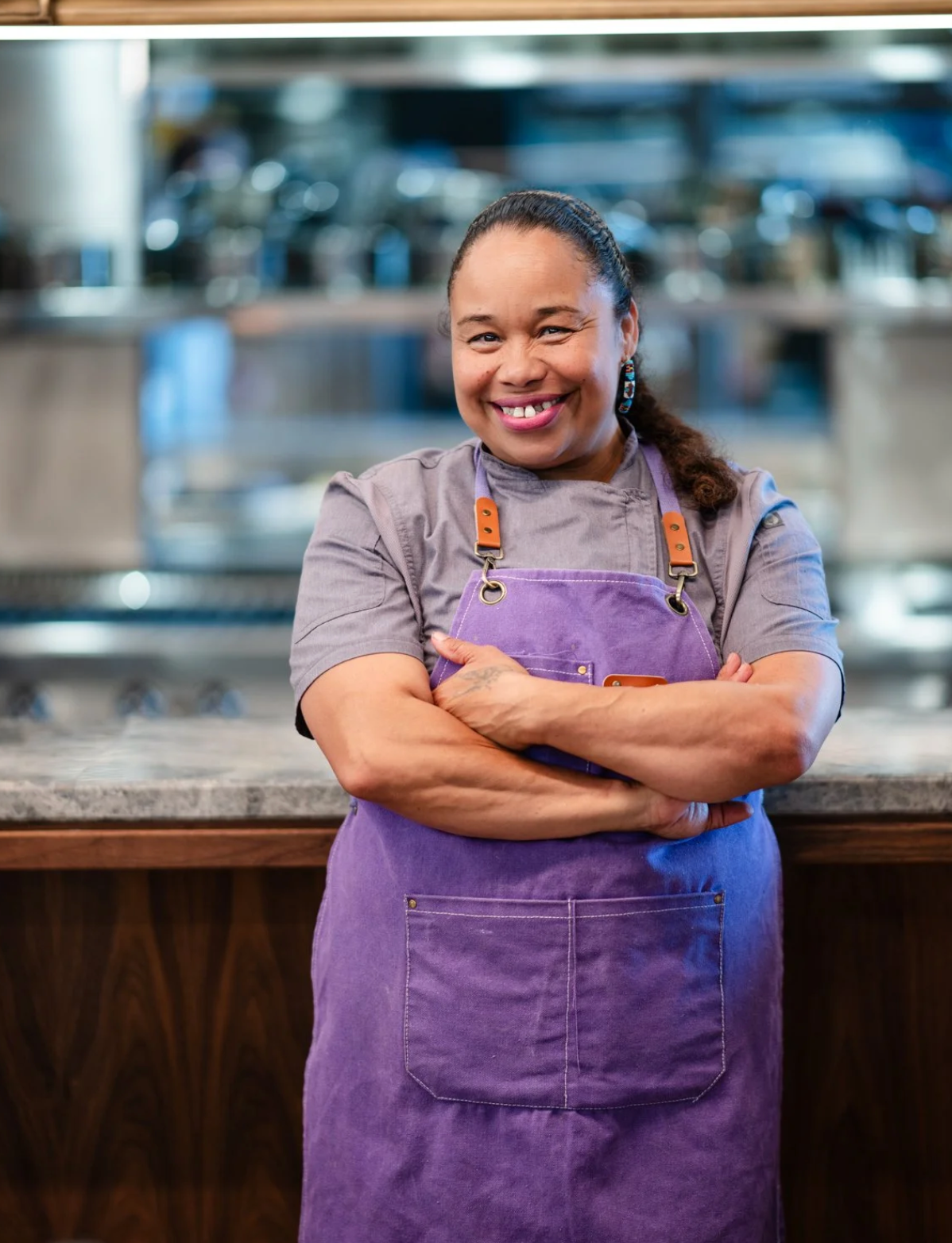
Native chef and influencer Crystal Wahpepah (Kickapoo and Sac and Fox) released her cookbook, A Feather and a Fork in March. She has been featured on Food Network’s Chopped and Beat Bobby Flay. She was also named as a finalist for the James Beard Award for Emerging Chef in 2022.
By Aminah Syed, Fry Bread Creative Visual Storytelling Intern
Fry Bread: What got you into cooking and becoming a cooking influencer?
Crystal Wahpepah: I got into cooking at a very young age – around seven. I always gravitated to the kitchen, with my grandmothers and my aunties, and they never kicked me out.
When I started to do online content, I just feel you move with the times, and it was fun sharing just different Indigenous ingredients. Maybe I’m foraging, or maybe I’m making a dish just to share with everyone, something everybody can make at home.
FB: You want to make food that people can relate to, but how do you connect your Native culture and roots into the food that you’re cooking?
CW: I grew up with the corn mush. I’ll make a corn mush where people, especially Native people, are, “Hey, wait a minute, I always used to have that.” They can relate to that part, but then you can add this ingredient, that ingredient to it and just really be creative, but then have fun. They can also represent the culture that you really come from, and where it offers medicinal [purpose]. I like showcasing those kind of things – it’s good in fiber, but then also it’s really beautiful on the eyes.
I also focus on where [food] really comes from. For instance, I live here in California. We have a lot of bay laurels, we have a lot of miner’s lettuce. It’s springtime. I really try to encourage people just to move into the seasonal [aspect]. This is what we’ve done as Native people for thousands of years. We move into seasonal. I’m a firm believer that we lost all that with commodified foods.
FB: What gave you the inspiration to move with the times and put all this online?
CW: I just do what I love, honestly. And how I move into the seasons, this is how we eat. I love farming. I love gardening. That was something I was really taught at a very young age. Then how do I become an influencer, I just really love what I do.
It’s not like I go out there and seek TV, TV seeks me. I’ve been really fortunate. I wouldn’t even know where to start, to be honest I had an opportunity in 2015 to be one of the first Native chefs on “Chopped.” I realized when they told me that I was the first Native to be on “Chopped,” I was really sad, but then also you get in a certain position where you have this responsibility to represent for the future generation. And I just so happened to be it.
FB: And you recently published a cookbook. What inspired A Feather in a Fork?
CW: Oh, well, it took me five years to write this book. Of course, along with my co-writer Amy. It was something I feel like is well-needed, especially for our future generation as people are inspiring to be indigenous chefs. It’s just really telling my story as Indigenous chef and recipes that I came along in life with. It really talks about what land it comes from, the medicinal, [and] what you can utilize.
I really try to make it where everyone can cook at home with it. I highlight the food producers that are in there. I highlight what region the food comes from. And I grew up intertribal, especially here in the Bay Area. I really showcased all the foods that I grew up with, but with the culinary twist to it. The corn mush,for instance, and it just so happens to be drizzled in a fancy way with berries. That is something that we always eat.
Then you also see my grandmother’s dried corn soup made with deer. That’s something that we still eat till this day. Like if it’s birthdays or holidays, I really try to really showcase all those. We have acorn; acorn is the California native food staple. I really highlight that in a crêpe, where people can taste. Everyone should be able to cook these foods and I try to do it in the easiest way.
FB: What was one of the things that you wanted to emphasize in this book about your culture?
CW: Color. It was color because I grew up with Native books, and they pretty much were my guide, but at the same time with cookbooks, there’s very little. We come from so many colorful, beautiful foods. And that was one of the things I wanted to highlight. I wanted to let everyone know these are our beautiful foods. That’s why you see the book is so colorful and this is what our landscape is.
FB: What was your proudest moment releasing this book?
CW: I think finishing it! But honestly, I got to do my first book tour, which I’m on right now. I’m at the Intertribal Friendship House [with] Tommy Orange, who wrote my forward to my book, and we got to sit down and do a Q&A with the people in the community that come from intertribal tribes in the Bay Area.
I did my second book tour, which was my lake in Oklahoma, Kickapoo. My family’s in Oklahoma, my tribe’s in Oklahoma. I’ve been on a sold out cookbook tour. I’ve never really dreamed of that, or even thought of that. I’ve been very humbled because of that. I’m still selling out on my cookbook tour. I felt like, wow, maybe this was something that was well needed, especially in the communities. I really focus on going into Native country, going into Native communities, and really showing this book and highlighting this book because I’m one of those people.
FB: What do you think you have learned on this tour so far?
CW: I learned a lot about people. I’m very humbled. It really tells you a lot. I’ve been at work for a long time doing this for many years and just how many people show up and really want to learn how to cook with Native ingredients. These are Native people that want to learn how to cook with these ingredients. I felt like it couldn’t have been a better time and to show everyone in the Native communities – especially here in the Bay Area or all over – how to cook with these ingredients, it’s been really embraced.
FB: What’s been the most exciting thing about being on tour?
CW: Oh, when I see young chefs, of course. When I see young, inspiring chefs, they really embrace the book, and they really want to cook with these ingredients. That’s who I wrote the book for, the future generation.
FB: What’s your favorite dish in the book? I’m very curious about that.
CW: I had created this choke cherry rub. You can put it on your beef roast, you can put it on your bison roast. But I really love pairing up berries to go with the meats that the animals love to eat.
FB: What’s it like being in the kitchen with your aunties and your grandmother?
CW: I come from a lot of strong women in my family. We always cook for community – outdoor cooking, especially in Oklahoma.
I learned at a very young age that community comes first as when you’re cooking. I can say I definitely took that away and my aunties are still feeding people to this day.
FB: Do you have a specific memory from growing up that you think about when you’re cooking today, or when you’re talking to the young chefs on your book tour? Is there anything that specifically comes up?
CW: Definitely. I like the sweet dried corn and how it’s harvested, and how we dry it out in August. It sounds difficult, but it’s really easy. At the same time, I always try to tell culinary students to find something you can really relate to and embrace that.
FB: What do you want people to take away from this book? What do you want people to understand?
CW: Oh, there’s intertribal all over the place throughout Turtle Island. It’s so rich and beautiful how our foods are, and what land they originated from. You have different recipes, But you don’t have those recipes to really describe where it’s from, what it’s utilized for, what tribe it’s from – things like that.
FB: What specifically do you want people to know about Native cooking?
CW: I always say that to be an Indigenous chef, it’s really cooking for your community. No matter where you go, it can be powwows, it can be a cultural center, it can be anywhere. If you take that in your heart, you always will be that giving person. Not everybody knows how to cook, but if you have the opportunity to cook for someone in the community, I say do it.