
Ingredients: Korina Emmerich on storytelling and sustainable Indigenous fashion in New York
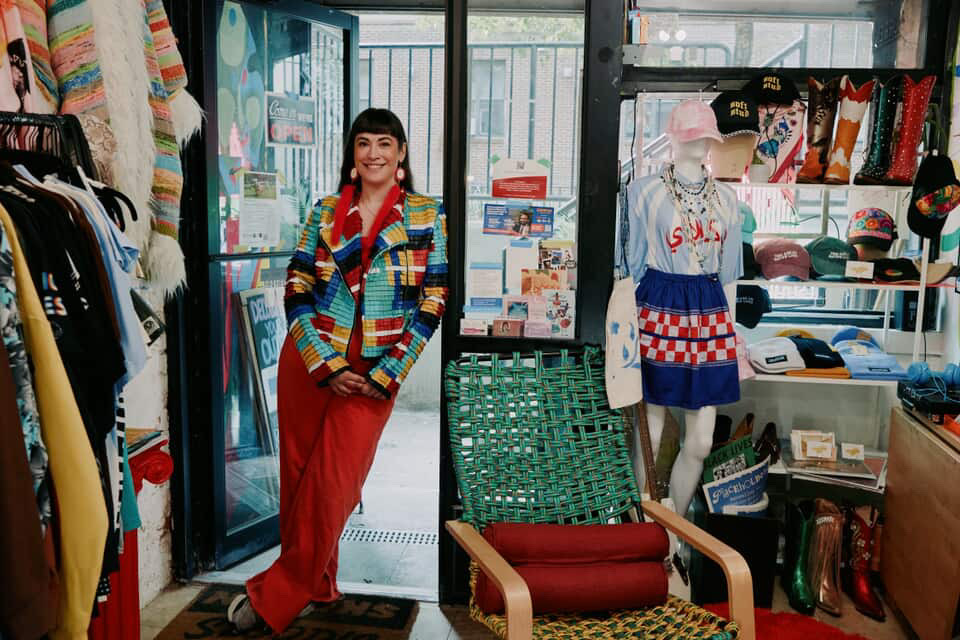
Korina Emmerich (Puyallup) is a fashion designer based in New York City and founded her own slow fashion brand, EMME. Korina co-founded and is the executive director of Indigenous New York Fashion Week. She is the recipient of the 2026 Pratt Fashion Visionary Award and has been displayed in multiple museums such as the MET and MoMA.
By Aminah Syed, Fry Bread Visual Creative Storytelling Intern
Fry Bread: What got you into doing fashion? How did that start?
Korina Emmerich: I’ve always been an artist and creative. Growing up, my dad was an art teacher. During the summers, we would do some art lessons with color theory and go through the books that he would teach, then do little projects.
I always gravitated to that, I always knew that I wanted to be an artist since a very young age. Around 8th grade is when I committed to following a path of fashion, that was always something I was interested in. I idolized a lot of designers and packed my walls with pictures from magazines. When I was about 14, that was the first time that I made a garment, and it was actually my jingle dress regalia.
I remember standing at the kitchen table with a measuring tape around my neck and thinking, this is my jam, this is what I want to do. There’s so much intention and thought and even prayer that goes into creating these works. That was always been a big influence on my creations and using storytelling through the work that I do and the collections that I make.
FB: With storytelling, how do you blend that with activism?
KE: Fashion is political at the end of the day. That’s always something that I’ve been interested in. I’ve never been interested in necessarily the commerce or production part of the fashion industry. It’s always been a way for me to express myself and my art forms. I use elements of education to bring attention to different issues or stories.
I did have the crêpe back satin Palestine dress that closed my last show, “Seeds”. I wanted it to be impactful and continuing to make it visible and talk about how there’s an act of genocide happening. I feel akin to what’s happening in Palestine and what has happened in the Untied States through colonialism and stealing land. Solidarity is important. My morals and ethics have always been at the forefront of my work in just the way that I produce. Working in sustainability and following the sustainable development goals that creating is more a way to protect people and the planet and being thoughtful.
A lot of my work that I’ve done, it brings attention to Missing and Murdered Indigenous Women, and discussing the meaning of the color red in a lot of our cultures. I’ve done a lot of work, in representing the Hudson Bay Company, which is something that I’ve always felt was a mission to talk about how fashion and colonialism pair together. Thinking about, the fur trade and just decimating a lot of our animal populations through westward expansion. I call attention to those things. I dig so much deeper into creating a design than, just trying to make something pretty.
FB: Your feature on Women’s Wear Daily, you were nominated and selected for an award. Can you talk about that award and what it means to you and how you got it?
KE: I’m being honored with the Pratt Institute Fashion Visionary Award for 2026. I just received an e-mail from the department that the dean had invited me to receive this award. It was shocking to me, sometimes I feel I don’t necessarily identify as a fashion designer because I don’t engage with production commerce as much as I have in the past. I found it very interesting that this award came about at this time in my work.
But speaking with them, I realized that The Fashion Visionary Award is about people who are challenging the industry actively making change.
I’m so honored that the things that I’ve been saying over the past, 10–12 years are being recognized. What’s behind the words that I’m using is a whole ton of people. Removing this idea of resource extraction and talking about circular design, regenerative design and our responsibility to care for ourselves and the Earth, as we are the Earth.
The ceremony is going to be May 14th. The person who’s presenting the award to me is Céline Semaan from the Slow Factory Foundation, who I’ve worked with multiple times. She was pivotal in helping me build a platform in sustainable design and radical design too.
FB: And how do you continue to amplify these voices in your fashion? What’s next for you?
KE: I’m currently working on a collection, which is going to be the preview at the MET called Material Lineages. I’m only using offcuts from previous collections. I save all of my scraps, I have bins and bins and bins of scraps. I’m sewing them together to create textiles, that is bringing in this idea of no waste.
Then, I am also working on how fabric can be a direct collaborator in the design. As I’m working, I don’t necessarily have a plan. I’m trying to free myself from being so strict with my work. I’ve worked with a lot of experimental musicians who have been inspiring to me to think about design differently. I’m experimenting a little bit more with this collection.
I’ll be doing a show in September during New York Fashion Week and doing a presentation of the collection. I plan currently to do it at the Museum of Reclaimed Urban Spaces to bring in that idea of reclamation in all different aspects.
One big thing that’s pretty cool is with Relative Arts, we’re actually going to be traveling to Australia in July and meeting with an Aboriginal designer out there, Delveen Cockatoo Collins, and we’ll be showing at the Concours’ runway show in Queensland. We’re going to be taking different Indigenous designers from the store to do the collection, to bring in as many people as we can to this other place and introduce as many North-South American designers from that.
Right now, we’re expanding what that representation of Indigeneity looks like, especially in places like New York City where we’re all different people, and we’re from all different places. I see little things, when 2% of the population in New York is Indigenous or identify as Native American or Alaska Native, that amounts to about 180,000 people. In this city, we’re so bulldozed over with all this Columbus bullshit. We want that representation of Indigeneity to reflect the people who live and work in the city, and how we’re not a monolith and we expand beyond borders.
We’re focused on doing outreach and continuing to build a representation of Indigenous design and talk about how there’s so many people. We’re put in a category, but we’re all different. It’s cool bringing all these people in, we brought a bunch of designers to the MoMA when we curated the Creativity Lab. I would like to build opportunity for more Indigenous designers and create those spaces for everybody’s voice to be heard.
FB: What is the thing that you’ve been most proud of recently in your work and in your collections?
KE: I’ve never felt prouder than when we produced the inaugural Indigenous New York Fashion Week. After the event, I remember just being in tears, seeing people’s posts saying, all my dreams came true. I walked in New York Fashion Week, I showed in New York Fashion Week, I got to go to these shows. It solidifies that these projects we’re working on are so needed in the city. I felt so proud of that.
I have also been proud of my inclusion in a lot of different galleries and museums. Just that recognition for the work that I’ve been doing, where it’s not necessarily my goal to make this for a museum. It’s just a creation of a visual that I have in my head and I have to make it. Having that recognition is cool. I’m 40-years-old now, and I’ve gotten to the point where I know who I am as a designer, I know who I am as an artist, and I trust my process, my work, and my ideas.
FB: For younger designers who are up and coming, what would you say to them when they’re trying to incorporate their culture and their history into their fashion?
KE: One thing I always say is, find a place you can stand where no one can push you off. Just think about designing from your perspective and trusting that whatever you’re creating is a part of you. The idea also of comparison can bring you down so much. It’s important to stay focused on your own journey and keep. You can keep things slow and learn and listen and build who you are and get to know yourself through the inspiration that fills your life. Just trust yourself and your work.
Another thing I would say is, if you are working towards being a fashion designer, to consider what your role is in creating more product in the world. The idea of creating, even creating waste, and thinking about the importance of what you’re doing or the story that you’re telling, what that means being brought into the world.
FB: Then is there anything at all you want to say about just the state of Native fashion?
KE: It’s about no longer asking for permission. That we’re at the point where it’s about building spaces for each other and seeing the amount of fashion shows that are being produced all over is so inspiring. That inspired us to create Indigenous New York Fashion Week, where we don’t necessarily have a voice in those spaces. It’s very predatory with the charges that a lot of runways charge you. They can charge you $20,000 to $50,000 for a single show, and I just feel that is taking advantage of people.
The other thing that is so freaking cool is the amount of Indigenous boutiques that are popping up that are sharing a contemporary Indigenous work. It is awesome that even at Relative Arts, our main demographic is Native people. We’re not set up there to appeal to a white gaze or sell things as collectibles or whatever. We’re selling earrings to our aunties.
The advancement of fashion Indigenous spaces has been so amazing to see in my lifetime. I didn’t have that representation growing up. I didn’t think that was something that anybody would give a shit about. Now, to see how people are pulling in different aspects of their culture and incorporating it in a way that isn’t fulfilling a stereotype of what we should be doing.
I always say, I don’t want to be just an Indigenous designer, I want to be a designer who’s Indigenous. I don’t want to play a role or check a box or fit into what somebody thinks Indigenous design should look.