
Matthew Kirk’s ‘Skinnin’ the Game’ turns everyday materials into personal language
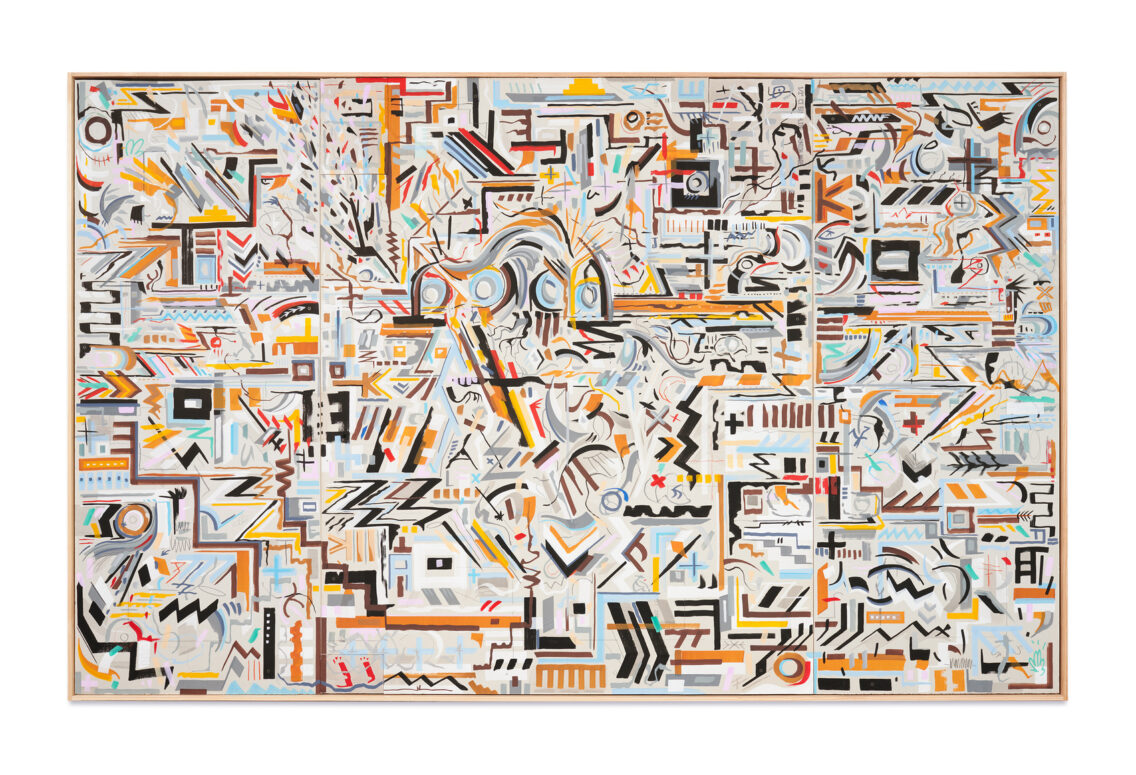
“Skinnin’ the Game,” Matthew Kirk’s first solo show at the Sundaram Tagore Gallery in New York City since joining its roster in 2025, brings together new paintings, sculptures, and a collaborative installation that feel grounded, intuitive, and closely tied to lived experience rather than polished spectacle.
Now based in New York, Kirk (b. 1978, Ganado, Arizona) draws from both his Diné (Navajo) and European heritage, as well as the visual texture of his surroundings—city streets, construction sites, and the kinds of materials most people overlook. His work often pulls in references to Diné textile patterns, but nothing feels strictly quoted; instead, these influences surface as part of a broader visual language he’s been building over time.
Kirk is self-taught, and that independence shows in how he works. Sheetrock, plywood, insulation foam, roofing paper—materials more often associated with construction than art—form the backbone of much of what’s on view. He uses them partly out of familiarity (he spent years working as an art handler after moving to New York in 2006), but also because they’re accessible, practical, and open-ended.
That practicality runs deeper than convenience. Kirk tends to use what’s already at hand, often holding onto scraps—wood, metal, feathers, found objects—until they eventually find a place in a piece, sometimes years later. Even his approach to color reflects this mindset: paint is used straight from the tube, without mixing, keeping the process direct and minimizing waste. There’s a clear connection here to broader Indigenous values around resourcefulness and respect for materials, though the work never feels didactic about it.
At the same time, the show makes it clear that utility is only one part of the story. Kirk’s real strength lies in how he reimagines these materials. His paintings and sculptures carry a sense of memory—childhood, daily routines, time with family—while also navigating the space between his Indigenous and Euro-American identities.
What’s on view
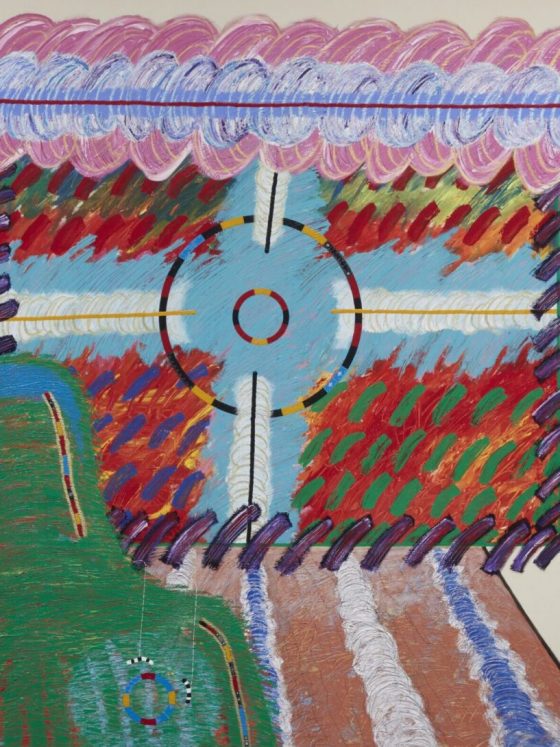
The exhibition includes a group of abstract paintings made directly on Sheetrock. Kirk skips traditional priming, letting the surface—whether gray, green, or off-white—act as part of the composition. Across these panels, his mark-making builds into dense, rhythmic fields, occasionally giving way to loosely recognizable forms: a face, an animal, a shadow. These moments of recognition feel fleeting, encouraging a slower, closer look.
The sculptures lean toward assemblage, combining objects like basketball hoops, tires, arrows, and drop cloths into forms that are sometimes subtly figurative. Kirk refers to them as “studio mates,” a nod to the long, open-ended process behind them—pieces evolve over time as the right materials come into reach.
At the center of the gallery is a three-sided bench made in collaboration with Brooklyn-based designer Ben Erikson. Built from one of Kirk’s own paintings on plywood—cut apart and reassembled—the bench invites visitors to sit and spend time with the work, rather than just pass through it.
Also included are sculptural paintings made from modular “tiles,” where individual elements come together into larger, three-dimensional compositions. These works extend Kirk’s visual vocabulary—symbols, gestures, and textures—into a more physical space, sometimes incorporating materials like roofing paper or plastic to shift the surface and tone.
About the artist
Matthew Kirk was born in Ganado, Arizona, and raised in Wisconsin. He has lived and worked in Queens, New York since 2006. Over the past several years, his work has appeared in a range of museum exhibitions, including shows at the Brooklyn Museum and the Hudson River Museum, where Smoke in Our Hair: Native Memory and Unsettled Time was named a New York Times Critic’s Pick.
His work is held in several public and private collections, including the Forge Project, the Everson Museum of Art, and the Eiteljorg Museum. In 2019, he received the Eiteljorg Museum Fellowship for Contemporary Native American Art.