
Ingredients: Patricia Michaels brings abstract storytelling and innovation to Native Fashion Week
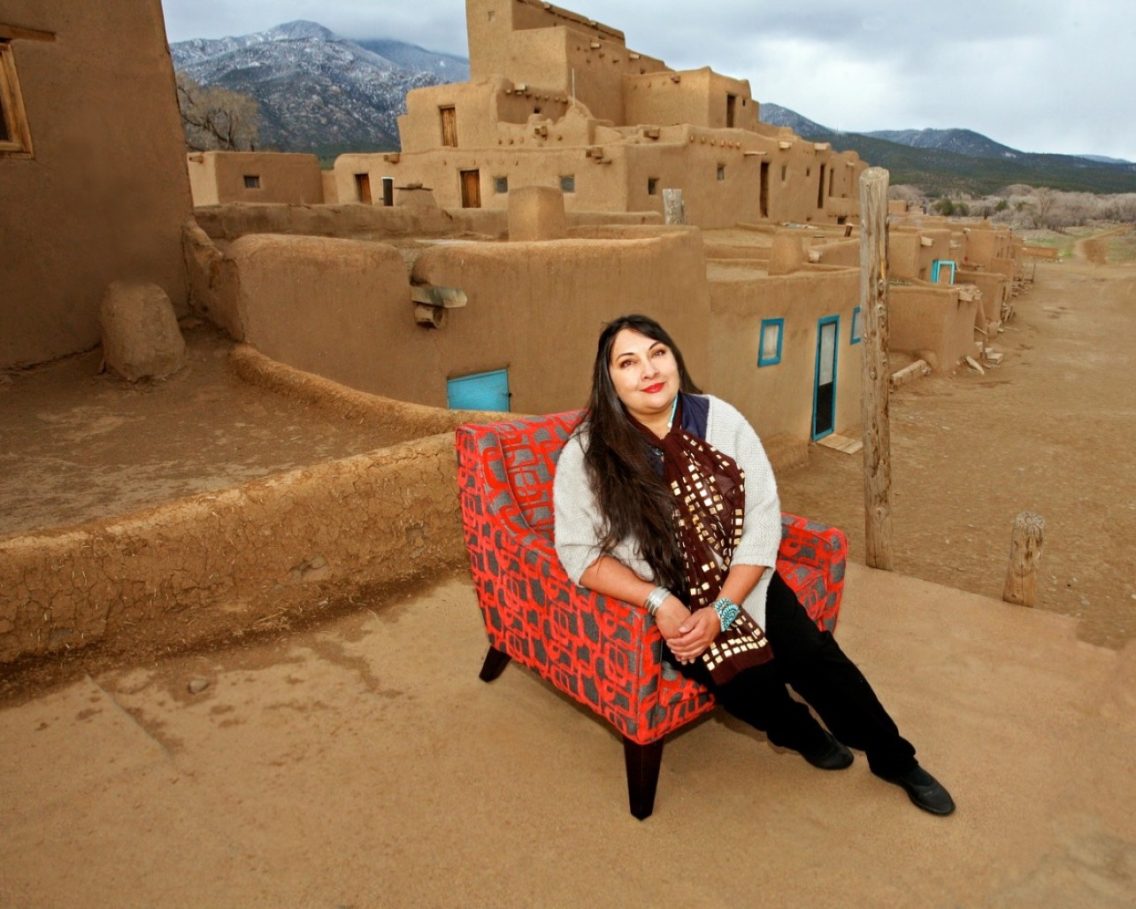
Patricia Michaels (Taos Pueblo) is a fashion designer, founder and creative director of PMWaterlily Designs and assistant professor at Parsons School of Design. She teaches fashion design, textiles and Indigenous courses on design and materiality. She is showcasing her art at SWAIA Native Fashion Week 2026 as a featured designer from May 8-9. She has been a part of New York Fashion Week and was a first runner-up on Project Runway season 11.
By Aminah Syed, Fry Bread Creative Visual Storytelling Intern
Fry Bread: What got you into doing fashion?
Patricia Michaels: I come from a family of dancers traditionally at Taos Pueblo, and then the powwow. I grew up with a very prolific family, always making outfits and going to the Santa Fe Opera since I was a little girl. Going parochial school and having to wear uniforms, I was surrounded by art growing up on Canyon Road. There wasn’t, there wasn’t a day that wasn’t eventful in my childhood. I was always surrounded by art.
FB: What art did you gravitate toward the most?
PM: You don’t gravitate towards any genre when you’re raised around and exposed around such a plethora of art. You can’t possibly. I had wall-to-wall Navajo runs, I had School of Taos Arts painters. There were modernist painters down Canyon Road. In the galleries there was Western art, there was abstract art, there was glass, Dale Chihuly – it’s impossible. I loved looking at work that was at the Metropolitan, at the Guggenheim at Peabody Essex. There’s just no way I could ever atone my inspiration to one genre, one period. As a child, I didn’t spend my time on the playground, I would ask if I could stay in the library for recess.
It always liberated me to know that the world was filled with creative textiles, textures, sculptures, architecture, paintings, pottery, glass. I was fascinated that people could make so much beautiful utilitarian or art, it’s just, what a world we live in.
FB: Did you have a defining moment in your life where you knew what you were going to be?
PM: It was in the second grade when I said, ‘you know what?’ I love textiles. I love sewing and draping, I would drape on my little dolls and on myself. I said, ‘this is what I want to do, I want to make clothes, I want to design things from all this inspiration and everything that I see and everything that I’m a part of.’ I don’t want to be limited. I want my vision to be understood.
FB: Next week is Native Fashion Week. How are you feeling, and what are you most excited for?
PM: I’m feeling compassionate, as usual, and completely grateful to be a part of such an important show amongst prestigious art designers. An organization that takes the time to jury and then produce beautiful shows. Seeing friends and clients and museum directors and curators, all of that culmination plus is something that I feel honored to be a part of. Now I’m bringing to the table my knowledge and my experience of being a professor at Parsons. That sacrifice of moving everything out to New York to live and work here and still be creative has been probably the one of the biggest challenges.
It’s such an abrupt challenge, and switching my career to divide my time of creativity in a whole different way is a real sacrifice. The work that’s coming out of it is going to be incredible, not only in ways that I feel I’m liberating my past, but in ways where I will be able to bring a lot of more resourceful opportunities to Native fashion. Sense of resource, production, scholarship, knowledge, just everything that I’ve always wanted to do, and I’ve tried to do, but didn’t have the kind of support that I do at Parsons.
FB: As a professor in practicum of what you teach, what lessons do you take from the practice that you do and give to your students?
PM: The practice that I do is always doing a self-check of who I am, where I’m coming from, what am I trying to convey to the world. I always encourage my students to constantly do a self-check and make sure that they’re being honest about where their influences are coming from, who they are, really taking the time to dig deep down inside and reevaluate constantly. I give that reassurance to the students that their individuality is important and not to second-guess it, but to nourish it and to give themselves that self-appreciation of how they view fashion and design and textiles.
They should not to stray from what they visualize, but to really nurture it and make journals and give it the strength. Traveling all over the world and having done shows all over the world, now the students that I teach at Parsons are from all over the world. It’s nice I have that understanding and relationship with them of where they’re coming from. Giving that compassion and really listening to their thoughts and their theories. I try to tell them that they’ll fail. they will absolutely fail if they copy and paste. I tell them to get into the feeling, into the mode, of where their inspiration is coming from and really fill it and explore it and then express it, I do not allow any copy or paste.
I don’t care if it’s from their culture, if it’s from their culture and they’re just going to copy and paste with their assets with it. I said dig deeper because what they were doing was contemporary then, give yourself that.
FB: What are you presenting at Native Fashion Week?
PM: I will not depart from all my hand-painted textiles, because that’s what I’m known for. Everything will have a bit of my hand-painted textiles. There’ll be felting, there will be the feeling of botany because it’s inspired by my cornfield. It’s not going to be what people think of the cornfield. It’s about what is unseen, the magic of life that’s growing and then the life that it provides for us. It’s in the theme of not copying and pasting.
It has to be the feeling that I get from when I see it transformed. I know that there’s water that comes from my sacred, beautiful Taos Pueblo mountain. That moisture provides water for the corn. There are animals that come and go from the field when there’s that provide nutrients. There’s elk and deer and horses, but they’re not depicted in there, just the filling of it. Textures are in there. Clouds, corn, kernels. It’s what the field goes through, even the hawks, eagles, crows, all the birds. It’s not necessarily going to be literally a bird, but there’s a feeling that I get from when the birds are there.
FB: What have you learned creating the pieces for Native Fashion Week?
PM: What I learned is that my clients don’t necessarily always want something that literally connotates a Native American’s design. Sometimes they want, they’ll come to me because it’s the painting on the textile might feel more artistic than giving them something that is just a print, that’s a surface design. I learned that makes me feel true to myself and I learned that that’s my driving force. That’s what gets me up, I want to create something. Something more abstract rather than always having to have something that is, going to lend itself to the iconography of Native imagery. I do those images, but I think at the end of the day, it’s always the ones that allow me artistic freedom.
I find that my clients want that place of acceptance of being individuals too, because they’re all collectors, they’re all curators. They want that, they want that respect acknowledgement too, they become my muse as well.
FB: Is that a consistent theme – being able to take elements of these feelings and being able to showcase it abstractly in your textiles and in your work?
PM: Yeah, in my aesthetics, in my silhouettes, in my painted textiles, in the texture of the textiles. All my muses get embodied into some part of the show. I’ve known some of these people for decades, so how can I just abandon them? I don’t go into my studio without bringing clients, patrons of art and museums, curators and even just maybe a piece that I saw in the museum. What I did as a child still is that what I do in my studio.
FB: What do you think is the most challenging part of creating that kind of art?
PM: Time. I mean, I’m so busy as a professor. The amount of time that I have is zero to nothing. The amount of detail that goes into these pieces is sometimes even if it’s bold, it’s still a bold and detailed piece. The amount of time is so encompassing.
The amount of work that I do, It’s just insane. Getting on the subway, getting off the subway, getting on planes. Flying constantly back and forth. The amount of time that I have at the end of the day to actually put in these pieces and regroup myself every time is a discipline. It’s just discipline that goes into it. Unfortunately in February, I lost nine people in my life. I didn’t expect this to happen.
I don’t know how I’ve gotten through and not gone crazy from that. I really don’t. I look at the dynamics and everything going on in the world and still waking up. If it wasn’t for the students being so brilliant, so ambitious, so happy and so talented, I don’t think I would have made it through that. They really appreciate my direction and I really appreciate being there, being reciprocal to working hard in the class. I feel really fortunate, I feel like I’m living the life.
FB: What would you want to say to your students right now about how they’re helped you with this semester and your career?
PM: If it wasn’t for their smiles and their work that they give me each and every week, they take the challenges, they do the reading, they do the research. If it wasn’t for them bringing something new every week to the class, I probably would have lost it. I would have felt like they weren’t appreciating life, and they weren’t appreciating the opportunities that they’re getting going to school at Parsons.
That in itself made me feel so strong and appreciative. When you lose somebody, it’s bad enough because you don’t know how to heal from it. When you see people take advantage of life, then it just, it hurts you even worse. But when you see these students working really hard and appreciating what kind of direction and education they’re getting, then the energy is just uplifted. If you can feel their smiles, you can feel the every stroke on the paper, the fine lines, the bold lines, the shapes, the tones, the textures, everything just comes together. Everything that you love then is put in front of you. Culture, diversity, inclusion, reciprocity, all of that comes together. Thenn you’re just feel like I can do this, I can get through this.
Even as you’re going out the door, you get the call that somebody passed away, and you still have to go to class. At least you go, and you see something that is beautiful.
As hard as it’s been, nobody knows what designers go through. sometimes they just think that we’re just living this life that has no challenges. The biggest challenge on top of it is being Native American. They think that we’re all the same, like apples and oranges, but each individual designer that’s out there comes from a different tribe that is so beautiful, that survived. And that was part of the hard thing.
Not everybody was from my tribe that I lost. You think about what’s going on in that person’s tribe when they’re being sent home and whatnot. You just have to just keep it together because you’ve been chosen to then be this professor to nurture these children and bring awareness in Native American fashion. It has to be respected, has to be acknowledged, and it has to have a place in the world of fashion. You still have to show up, you still have to get the work done, you have this immense responsibility.
FB: What have you learned generally through this experience?
PM: The biggest takeaway from it is to never stop feeling the gratitude and feeling all the beauty that you do have around you. That’s your self-love and that’s your self-care. If you don’t have that self-love and self-care, you’re just going to fall apart. My children, my family, my husband, my people at home, my students, my colleagues, my daughter-in-law who is my roommate. All of this stuff gives you that sense of grounding.
What you learn from it is that being true to who you are and not trying to take on something that you’re not, is gonna be your strength. That sincerity and that love that you have, you can’t pay for that. You just have to enjoy it.
You have to remind yourself that you have that by way of taking the time and being in the moment, reaching out, reaching out to all those people every once in a while, just letting them know you’re okay, asking if they’re okay and vice versa and working on projects together. Work is always my salvation. That’s a crazy thing, that’s the one thing I know for sure I have.
FB: If you could say anything about your art and your passions, what would you tell the world?
PM: If I could say anything about my art and my passions, it would be that truth is, truth is your best tool. Don’t sell yourself for cheap, because the work that goes, that comes from an artist, is a lot. We’re not a place to be bartered with. We don’t go to the grocery store and get to barter or pay our bills. So don’t do that to us.
I want to thank SWAIA and my fellow designers for showing up with the best of their work and doing what they do, because we’ve got to be that inspiration for the next generation. Just by way of showing up and doing the work that we do, I appreciate all of that. Everything from hair, makeup, jewelry, accessories, all of that.