
Ingredients: Suni Sonqo Vizcarra on the Andean roots and ancestral power of the antara
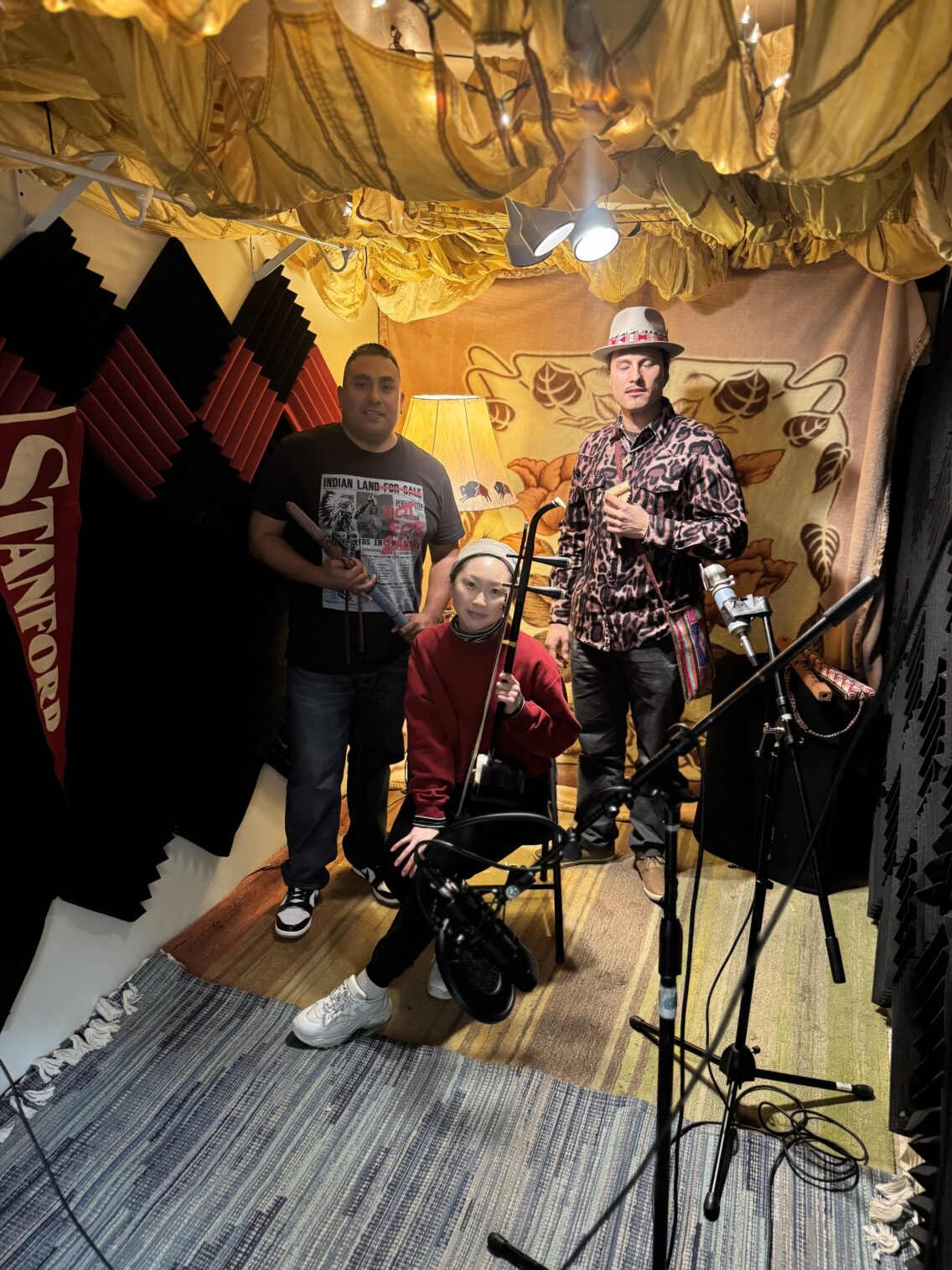
Suni Sonqo Vizcarra Wood (Quechua Nation, Peru) is one of the musicians on the new album Niiwin. He is an artist who plays the antara in this album. He has been playing it for many decades as it passed through his family.
By Aminah Syed, Fry Bread Creative Visual Storytelling Intern
Fry Bread: What instrument did you play or did you play and recorded for Niiwin?
Suni Sonqo Vizcarra Wood: It’s called antara, a flute that’s within the panpipe family. It’s a pre-Colombian instrument from the Andes. The Andes is known for being one of the places in the world with the most variety and diversity with wind instruments.
All kinds of materials were used in pre-Colombian times, everything from clay to reeds, bones, metal. In this case, the antara that I’m playing is made out of a type of bamboo that grows here, it’s called carrizo, it is played in northern Peru, where my grandmother is from.
I actually play that instrument because it is played in my family. My grandmother played it, then my dad plays it, and I grew up playing it. It’s passed down within my family and antara is a very important instrument in my daily life.
FB: What got your family into playing antara?
SSVW: It is part of our culture. We’re indigenous to the Andes. My grandfather is Quechua from the Chumbivilcas area, which are high grasslands in Cusco. My grandmother, she’s actually from northern Peru, where the mountains meet the rainforest. The ancient culture there was the Chachapoyas, that instrument has been part of before my grandmother.
Here in the Andes, music is a very important part of our calendars. Throughout the year, we have many different celebrations and rituals that are very closely tied to the agricultural cycles and the cycles of astronomy. All of our dances have to do with the time of year and the season. There’s some flutes that we play to bring the rain or some flutes that we play when we want the winds to come and the cold season to come. Usually in the traditional communities, when it’s the time of year to play a certain instrument, most of the community will participate in playing instruments and singing and dancing. It’s just part of our culture to learn how to play the music and dance and sing because it’s our collective gathering and communal celebrations.
FB: Through the experience of working with Darren and with working with Annie and the erhu, what do you think that you learned from this cultural togetherness?
SSVW: Well, there’s certain things that we have in common. First of all, musically, I always find that a lot of the traditional Asian music is very similar in many ways to Andean music, especially the music that we play nowadays where we incorporated string instruments. Because before the Spanish invasion and colonization of South America, there were no string instruments.
Later on in history, we incorporated string instruments into our traditional Indigenous music which is something very unique from here is that we play super traditional and indigenous music, but with string instruments incorporated and the way we play it, it’s very pentatonic and even the sounds that these new string instruments make, I find very similar in many ways to instruments the Erhu and other string instruments from different parts of Asia that I’ve heard.
Even in traditional singing here – the women’s super high-pitched notes – I find similarities with some Asian ways of singing. Obviously with North America, Indigenous peoples, we share so much in common. I really, truly believe we’re one culture with a lot of diversity. There’s cultural diversity, but we have more similarities than things that differentiate us. Within that diversity, we are one people, all the way from the North Pole to the South Pole. They don’t teach us enough of that history. It is the right time right now to start these projects of reconnection and building bridges amongst our cultures.
The music that we’re playing, even though in this album it’s all improvisation, it is those sounds that come from our ancestors. They’re flowing through us, flowing through the instruments. That’s the way I view it. It’s a way of giving our ancestors and those silence, forcefully silenced voices a voice in this way through music. It is important, and I would like to see more of this type of collaborations happening, but always respecting the traditional instruments here in the Andes.
Unfortunately, there’s a big new wave of what is being called Andes music, but it’s not respecting at all the traditional unique tunings and measurements of the flutes and all of that knowledge is being, is getting lost because of this new era of more Latino-Andean instruments and flutes that take over and end up replacing what is authentic and really indigenous with our ancestral roots. It’s also a responsibility in that sense. I feel like it achieved a great balance, this album, between traditional roots and authenticity, but innovation and flowing with improvisation and that dialogue between the three of us.
FB: You and Annie both mentioned a lot about the improvisation of your instruments. What did that look like, and how did you reach that flow state with your instrument?
SSVW: What’s really interesting about this project and what makes it unique, and I feel like most people that will listen to it might not know, is that there was no rehearsing. We rehearse a piece together, and then we record it.
I think there was a lot of practice just individually. Me figuring out what flutes to take, which ones can match Darren’s flutes. When it came to the actual moment of recording, it was all spontaneous, on the spot, just listening to each other and flowing. It’s all improvised in that moment. That’s really incredible because those songs capture that unique moment that can’t be replicated. That was really special to me.
I felt kind of some pressure because there’s just one take. If something doesn’t sound right, then we have to record again, which didn’t really happen. We just flowed. It was a really nice moment of flowing with my instruments, but having to be really in tune to Darren’s flutes and then Annie’s erhu. It was a unique and a new experience for me to record in that way. I really appreciated it because of that.
FB: What do you think that you learned from, improvisation, and you’re not newfound appreciation with being intentional and really connecting with your flute?
SSVW: I learned that if you’re grounded in your roots… that same spirit is still flowing through the instrument. You can feel the Andean roots. In the improvised melodies that I’m creating, when I hear back the tracks, I can really feel that it’s completely sounding Andean.
But at the same time, it goes so well with the erhu and then with Darren’s flutes that it taught me to be more open to that fluidity. It taught me that there is a balance that can be achieved where you’re still representing your culture, but just being yourself in that moment and creating something completely unique and new. The balance between innovation and tradition and ancestral knowledge that is passed down, this was a great example.
I feel that’s also a teaching, something that I learned, and even though we didn’t know each other at a personal level there, if we could still weave these sounds together in that fluid and in a very balanced way.
FB: What do you think you’ve learned about yourself and your culture from this album experience?
SSVW: Music is something I do because it is part of my culture. I’m actually an artist. I’m a sculptor and a jeweler. I do some film on the side. I do many things, but I’m not a professional musician that does that as my main path. I think this project showed me or gave me more confidence that I should be focusing more of my time and creativity into creating new projects with music.
That’s something that I learned about myself is that I do have the capacity and the talent to a certain point. I knew I had the skill because I’ve been playing music for many, many years and I have done recordings in the past, but not in this type of way with very with a lot of improvisation. I think there is great potential that I want to explore more within my own creativity. I learned that for myself.
FB: What did you learn more about your culture and playing , andwhat did you learn more about playing the flute and that connection that you have with it?
SSVW: Well, something that I learned is that to preserve tradition, we often keep passing down the same songs, and then every now and then. A really well-developed musician will create new songs. This improvisation made me think that all of these traditional songs that are passed down were invented and created and were born from just letting creativity flow at some point. Someone way back came up with that melody and then that was passed down. In such a critical moment where our culture is at risk, it is good to hold on to those traditions and pass them down really purely and intact. To pass down that ancestral information in music as well. But I feel like it is important to not stop creating new things.
Innovating and letting creativity flow. I feel like we have survived because we haven’t stayed stagnant. We have moved and adapted to new times. That brings me back to the teaching of preserving, but also dreaming, innovating and creativity. It taught me that about my own culture, that we are resilient because of our capacity of adapting and our creativity. That’s what makes us resilient. That is important to also cultivate that.
FB: Speaking of creating and creating new things, what’s next for you artistically and even if you’re planning on maybe possibly recording new music in the future?
SSVW: Well, speaking about the music side of my creative path, we are recording more stuff. In the past couple of years, I’ve been trying to build a home studio. I’m at a point where I have all the basic equipment, and we have recorded a recent album of our traditional music, which is a list of 24 songs that are traditional that are passed down. Now we’re working on the first few songs for another album that we’re in the making of, which is also traditional music. These are all new and original songs from different members of my community.
This album is going to be all original songs, but within the traditional style. I’m excited about that project that will probably take several months to accomplish, maybe even longer. But in the meantime, I also want to explore more of my own music production. I want to make something that incorporates our instruments and sounds, but that doesn’t displace existing melodies that belong to a specific cultural context.
This is important to me because I see that happening all the time with our music here, is there are all kinds of modern music, everything from rappers that use soundtracks where they mix hip-hop beats with traditional songs. It sounds really cool, but there is not a clarity of how far one should go with still being respectful to your culture.
A lot of times I see these rappers using music that has a really ceremonial context, and they’re using it in this really commercial way without permission. Whom do you ask permission? Because that’s not one person. It belongs to a whole culture. It is very problematic; because I grew up in that traditional practice, I don’t want to do that. I don’t want to grab things that exist in a specific context, cultural context, and display some to create something different. There is plenty of potential to still use our instruments and play new melodies that don’t belong to a ceremony or a festivity, and have it still sound Andean or Indigenous, but being respectful.
I think there’s an important conversation that needs to be more present within artists nowadays, Indigenous artists, making contemporary music is the cultural responsibility and ethics. I feel I don’t see that happening, that conversation. I want to be part of that, and also create examples of music that are successfully mixing Andean sounds with modern music, but still being respectful and careful, delicate with our culture.
FB: What is the key takeaway from that you would want people to know about striking that perfect balance of including culture without disrespecting its foundations and traditions?
SSVW: There’s two things that would make a big difference. One is respecting the traditional instruments and the measurements, the tuning, the sounds that to a lot of Western musicians might sound scratchy or untuned or messy, not clean enough. That’s what makes it special because a lot of our instruments are actually imitating sounds of nature, sounds of birds, of animals, of different times of year. it’s very organic and spontaneous.
The other one is what I mentioned is not using melodies that already exist and that belong to specific cultural contexts. That’s what I would want people to take away, is that there’s no need to do that. That’s problematic and it’s disrespectful, even if it’s an Indigenous creator doing it. We can still play music, we can still use our instruments and create new original melodies for our contemporary projects [but] let’s not use our traditional songs.
FB: For you, what makes upholding these cultural practices important?
SSVW: As an artist – as an Indigenous artist – living within a contemporary modern world and trying to navigate a contemporary art world, which includes a contemporary music world, it is very difficult sometimes, to live and practice my traditional culture and be true to that. It is difficult try to navigate the modern world where we need to make income, and we need to be financially successful as artists.
The problems we run into with that [the challenge] to represent our culture but not make it commercial and not exploit our sacred aspects of our culture, is something that I feel we’ve run into a lot as artists. I feel it’s really important to not leave that conversation aside ever in our careers and constant communication with our own people, our own communities. A lot of these decisions can’t be made by one artist, but it has to be a collective voice speaking through the art.
At least in my practice, that’s really important; it’s not just me deciding things and taking and self-proclaiming me as a representative, but really giving the opportunity of my art to speak for a collective voice. I’m a very active participant within my community, and I’m constantly receiving feedback. I feel that is a practice that every Indigenous creator, artist should have is communication with the source. If we only focus on innovation and the modern world, but we don’t cultivate the roots, then we are breaking the connection with the past, with that ancestral knowledge. There has to be a continuity of the communication from the roots to the wings.
We spread our wings and fly into new worlds, new dreams, but at the same time we have to keep those roots nourished and strong to maintain that connection.