
Ingredients: Darren Thompson and merging traditions in music
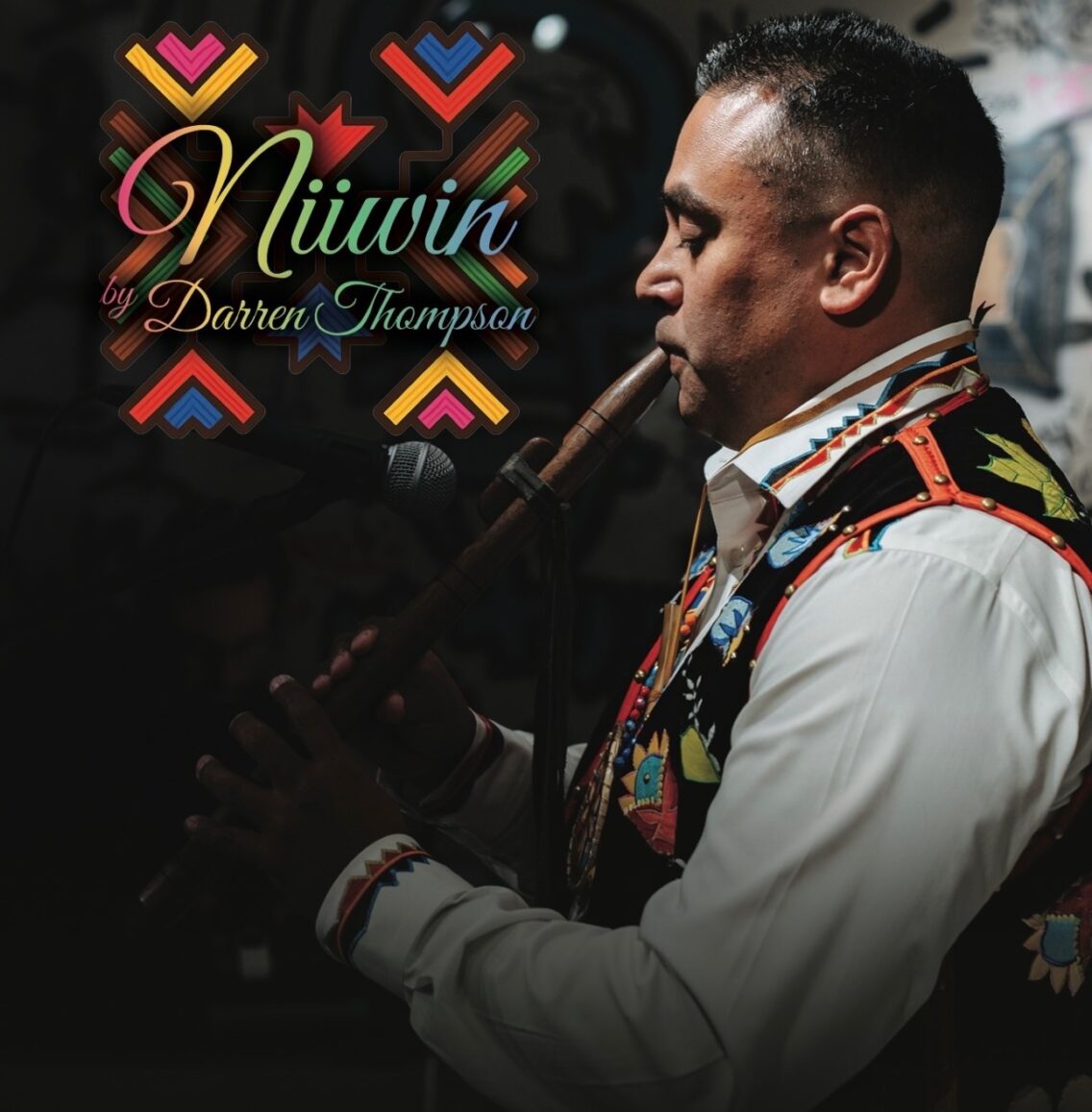
Darren Thompson is an Ojibwe flute player and an occasional contributor to Fry Bread, who has released his fourth studio album Niiwin. Fry Bread caught up with Darren to learn more.
By Aminah Syed, Fry Bread Creative Digital Storytelling Intern
Fry Bread: Can you tell me about the album? Let’s start off with that.
Darren Thompson: This is my 4th studio album, and it’s titled Niiwin. It means “four” in my Ojibwe language. It also incorporates different musical styles from different cultures beyond North America. For me, this album demonstrates the performance ability of the instrument that I play, which is widely referred to as the Native American flute. In the broader world of musical instruments, it’s generally the North American indigenous flute. This album involves and includes multiple indigenous flutes, not only from North America.
I perform the flutes from North America and I have a South American indigenous flute player on the album as well, so our styles are different. The challenge with the album was blending my style, which I’ve always been a solo performing artist, to blend with one another musician and/or two musicians, which is the case in this album. This album also includes the Erhu, and it’s a Chinese violin, that it’s a two-string Chinese violin. It’s different from the European violin.
The denominator in all of these instruments is that they’re non-Western musical instruments. Therefore, they’re non-Western music, they’re on non-Western musical scales.
The album was recorded in two locations. One is in Auburn, Calif., which is not too far from Sacramento. And then the other components of the album are recorded on the Pine Ridge Indian Reservation at the Oglala Lakota Art Space, which is funded by the First Peoples Fund. The Oglala Lakota Art Space is available at no cost to any person of a tribe that wants to record, whether that be music, whether it be language, whether it be stories. You just have to book your time and make your way there. That in a nutshell is what’s different about this album than my last three albums.
My first three albums were all solo. This album is not entirely my composition. There are several solo songs by the other musicians, so it gives listeners an opportunity to kind of listen to their style and listen to the instruments while they’re played solo.
FB: What is the story that you’re trying to tell with this collaboration of different tribes and different cultures in the music that you’re making?
DT: The story that I am hoping to tell is that I’m uniting these different musical traditions for a really historic time – not only in the history of all of music, but even in our own lives. In the project, there’s three individual creatives that are involved in this. (Well, there’s more if you consider the recording engineers.) But the story that I’m telling is one of unity and one to be hopeful of where we are going by reflecting on where we all come from.
I believe that and feel that our musical traditions have survived for lots of reasons, love, creativity, connection. I think that speaks for not only myself, but the others involved in the project as well. It took an act of vulnerability for me, and that was literally asking these musicians if they would consider recording with a Native American flute, and they immediately responded with enthusiasm, that they would be honored to record. It took multiple years to put it together, started from there, and then I was like, ‘how am I going to afford all of this?’ It was expensive. And what I did is I booked a full summer of performing at the Crazy Horse Memorial, saved my money and paid them out of all in my own pocket.
FB: How did you approach the vulnerability of asking these other musicians?
DT: It just so happened that I met these individuals on my travels. One of them was for a chamber orchestra show I did, another one was at a film festival and watching them and hearing them perform and seeing their expressions, I felt was what moved me. The music was a really good part, too, but just the way that they express their knowledge, their emotions, and captivating a listener to these historical instruments, these instruments that have more than a thousand years of history. I was in soft tears; my eyes were all swelled up while I was watching them in the studio. I just felt so honored that I could support them.
That’s kind of where the vulnerability came from as well, because I’ve been a self-supporting artist for many years, and I don’t want to gripe and say I haven’t had much support, because that’s not exactly true. But, being out, and they’re young – they’re in their 20s, I’m in my 40s. I was just like, ‘I see you. I want to believe. I believe in you. I support you. And let’s try to see what we can make happen.’
FB: How do you want to continue being collaborative and helping people in their youth?
DT: I think being open to what life can bring you, as opposed to [not]. And there’s a balance there, because as we know, we need to have boundaries for the protections of ourselves, of our spirits, of who we are. I think artists in general are vulnerable, just in nature by sharing their art because one, you don’t know if you’re going to offend – or someone may not like what it is that you’re doing. As a result of knowing that and having that experience, I knew that when they presented themselves that they knew that they were vulnerable. I connected with them on that level.
FB: Can you talk more about the importance of connection with your music and this album? How do you hope that it inspires your audience?
DT: Connection. I think for me, you know, there are a variety of types of music that exist. It’s unlimited. I don’t know if there’s an exact number and that’s not the point. The point is, this type of music has paved a lot of good things. A lot of good things have come to me and I don’t mean by performing it. I mean just by like being in my life as in listening to it. That it allowed me to slow my thoughts. It allowed me to reconnect with who I am, and that’s what music can do. A lot of it doesn’t have to be this style of music, but this was this particular connection for me personally, and as a result, that’s what I wanted to continue to share and inspire with people.
And with this album, my hopes with connecting with the audience and/or hopefully, you know, others is that this instrument, its ability to express yourself through the instrument is not something we really hear in mainstream society. We hear the all the names and these and these are people who are backed by large commercial contracts, large visible media companies. This is just a little different. So it was my hopes for this album is to contribute to the history and documentation of the style of instrument that I play, as well as the other instruments. But that was the main intention.
FB: Can you talk more about how just the general process of producing this album? You said it took a really long time, how many years did it take exactly?
DT: I would say it started, the concept was, the concept was thought of prior to when I met my first musician, which was in the fall of 2022. I then met another talent in the fall of ‘23. When they both said yes, I then realized that I had a project that would stand out, and I think would be a remarkable experience to have. And so from there, I had to find a way to fund it. Fortunately, what came into my life was a very significant residency to do music, which then I just saved to invest back into my music. So overall, the project took a good four years, a good four years from the moment I met my first musician to the moment. I’m still literally waiting for it to be published.
FB: What does that review process look like?
DT: Most things are done digitally now. I have to submit to a digital distributor and there’s a variety of them. And from that digital distributor, it goes out to all major stores. However, people access music on their phone or their computer, you can access my music that way. So that means Apple, Spotify, Google, Amazon, Pandora, YouTube, iHeartRadio, the list goes on and on and on and on.
FB: What’s the thing that you’re most proud of on this album?
DT: There are several things, but the one thing I’m most proud of is the ability of bringing together. The amazing talents that I believe are going to continue to do amazing things with their craft. To me, that I thought that was such an honor that they were willing to give me their time, their talent, and their experience.
That was an accomplishment in itself. Gathering people takes effort, it takes work, it takes timing, it takes planning. We all have lives, we all have things to do, and the ability to get us all together at some remote recording studio, I think was like the most thing I was proud of because at any moment I saw, oh my goodness, it’s like a house of cards, like one card is going to fall, and when are we ever going to have this time again, right?
I’m sure we could find it, but the reality was all my personal resources were invested into this and that, you know, I would take a significant amount of time and additional resources to make it happen again.
Performance-wise, music-wise, there are some songs that are really, really good, like that really stand out from my other projects and the other songs that I composed. And one of the songs is a love song that I composed, and I performed with it on, so now this is a technical component, but I play left-handed. So my left hand is down to the bottom of the flute. Now with this other instrument, I played it with my right hand to the bottom of the flute, and it’s a right-handed instrument. And with that, I performed a song I had envisioned that had been inside of me and I just let it go. I just let it go in the studio and I was very, very proud of it.
FB: How should your audience take in the album, and how should people listen to the album, like from start to finish on shuffle?
DT: Start to finish. I curated it to demonstrate how people recognize my music, which is solo. The first component of the album is just me solo. And then I ease my way into performing with the violin. Then I start incorporating with the other flutes that are involved in the project. But also, different people like different things. I don’t know if people are going to like me performing with a violin, you know, I really don’t. But the point is, I’m comparing the instrument and my performance style with that particular instrument.
FB: What should people be listening for in an all-instrumental album? The meaning can be very interpretive to each individual.
DT: These old musical styles and instruments have found their way to each other through many different twists and turns. And we were able to create something that we probably have never envisioned. That in itself, I think, deserves a shot.
FB: Is there anything you want people to know just generally flat out about your art, this album, generally?
DT: This album includes decades of research and performance experience. I just think that it’s an accomplishment publishing it – the professionalism in the album is really great. It really stands out from my last albums, and that this musical genre is still thriving. It’s a very beautiful contribution to the world of music.
FB: How do you want to keep the genre alive and keep your musical legacy alive at the same time?
DT: I mean, essentially releasing the album is a big part of keeping the genre alive. Also, you know, like these people have, their own following, their own base, their own supporters, and it gives them an opportunity to learn more about my music and my genre, right? And that may influence other musicians, that may influence other listeners to want to explore listening to more of this kind of music, right? So, and how that keeps my legacy alive is I’m basically demonstrating the growth and development of my performance style. You know, you can listen to album one and album four and be like, wow, right? Even me, and I’m a big critic.
Listen to Niiwin on Spotify and YouTube.