
Ingredients: Nephi Craig on his new book, Our Knives Will Save Us
It’s not just the Ingredients of a dish, it’s the Ingredients of a Chef.
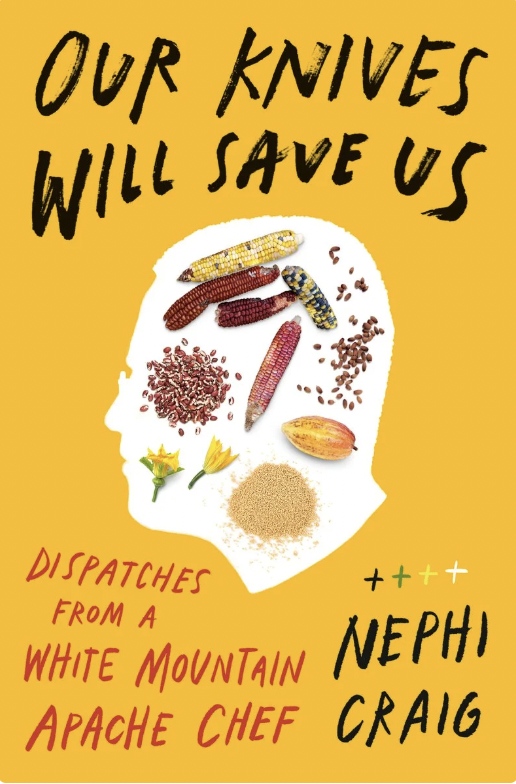
Chef Nephi Craig, White Mountain Apache and Diné called us from Whiteriver, in Northeastern Arizona where he lives and works, to talk about his new book, Our Knives Will Save Us: Dispatches from a White Mountain Apache Chef (Penguin Press), which goes on sale July 14 and is available for pre-order now.
Full disclosure: Nephi is a friend and relative, and we’ve covered his work in the past.
The following interview has been edited for content and clarity.
###
Fry Bread: You wrote a book! Can you tell us why you wrote this book?
Craig: I wrote this book because I wanted a message of Indigenous foods to get out in the world in a different way, from a Chef’s perspective. I am excited about doing a cookbook someday, but I decided that doing a memoir and a big idea concept book would be a good way to write a parallel story of how Indigenous foods have changed my life as a person in recovery, as a dad, community member and as a chef. And I really wanted to kind of timestamp some of the work that I’ve done over the past almost three decades I’ve been committed to and practicing my style of Native Foods.
I’ve been working long and hard and doing stuff, and I felt like it would be cool to have a story that talks about the ingredients of a chef, not just ingredients of a dish.
Fry Bread: Can you talk a little bit about some of the ingredients in your story?
Craig: I first entered a kitchen in 1998, I think it was at the tail end of very racist, violent, terrible kitchens, like even the best ones in the Americas, were still like that, even in the United States.
Everything was very much Eurocentric, French-dominated. Everything in the industry seemed to always be awarded to French-themed, styled, or specific French style restaurants.
When I got into professional cooking, kitchens were set up very classical and whatever you wanted to aspire to, that was going to be the template–and I, I took the hook line and sinker.
I didn’t know any other way. And, you know, fortunately, 28 years later, we’re seeing our industry go through some changes. There is still a lot of work for us to do across the board, but, I think that now there are more options and more opportunities that just did not exist or seemingly did not exist, back when I first started.
I wanted to paint a picture of what it looked like, and some of the things I experienced as a Native kid. I was in my, you know, 18, 19, 20s. And it was difficult, clashing with stereotypes and lack of knowledge, and a lot of racism and humiliation and abuse.
That’s one dimension of growing up in a kitchen, and I’ve made a lot of conscious decisions to not operate kitchens like that. I want kitchens I work in, or that I help to run to be more centered on balance, discipline, goals and systems than intimidation, debauchery, and racism, violence, all that junk. And I think we’ve gotten there with the place we have now Café Gozhóó. It’s a pretty intelligent, cool, smart, fun young Apache spot on the rez.
It’s kind of a contrast from where I started and where I am now. I wanted it to be an illustration that it could be done, that we have moved forward as Native chefs, and we didn’t move forward in the way that our French mentors might have wanted us to. Or, Europeans, in general, might have wanted us to follow their template for what they wanted us to practice as Native chefs. We didn’t take it.
And then also being a dad, throughout my journey. It does involve addiction and recovery, all the ups and downs that come with that–from being in jail, being on probation and feeling like it was very dark, and there was every opportunity to quit and just throw in the towel and switch careers to something more lucrative and more balanced or whatever, but I just felt like I had no option back then when I was younger. My youthful thinking was to not give up. And that’s what I chose to do, and I hope that maybe readers can get a sense of Indigenous tenacity and how strong our passions can be when we put our mind to something. And I hope readers can be inspired to not give up on whatever goal they set for themselves. Maybe even see how some of the experiences that were negative in the kitchens I was in, they can avoid those. Things like burnout and alcoholism, substance use and misuse. Those kind of things that I participated in, it wasn’t worth it, but I couldn’t see that back then.
These three things are kind of all interlinked to becoming a father.
My first born was in 2003. Your first child is always going to be the most anxiety causing, and most joyous. All kinds of new things come with being a dad for the first time. That has been an amazing journey of recovery between me and my oldest son as well. He was there, very young when I began to enter recovery. And you know, I had to just let him know, like, okay, we’re gonna be doing this together, and we’re going to heal together. And I’m gonna show you, you can trust me.
Three, real, strong, powerful, parallel stories all centered around food because they were the catalyst for a lot of the spiritual blessings and anchoring.
Native food was even a catalyst down to brain structure and supporting relapse prevention by providing a diverse range of proteins to support neuroplasticity and brain health. They’re really essential–part of how I was able to stay sober, at least for me for one person.
Fry Bread: One thing we really appreciate about the book is not only does the reader go on this journey with you, but you do offer the reader the experience of healing with you. And healing through the things that you experience and learned along the way. Can you talk a little bit about those lessons that you put in here and what inspired you to share what you did?
Craig: Myself, as a clinician and a recovery specialist in my work, I do my best to break down heavy topics into everyday fun speech metaphors and I want to make recovery tangible. I don’t want it to be over complicated and I want recovery and cooking to seem like anyone could do it.
For too many years, I presented foods and cooking that were very expert and very technical, very intricate, and it seemed like you needed to have super specialist training, which is true to a certain extent. But cooking is for everyone. And I like to say nowadays, if I can just get people to start cooking and enjoy the act of that, that’s that success to me.
So that’s one reason why I wanted to have simple metaphors and funny humor and tips and tools peppered throughout, because that’s how I’ve learned, to maintain my wellness, not just my sobriety, but just wellness in general, because I know not everyone that reads my book is going to be in recovery from addiction or substance misuse. But everyone is human. And so I wanted it to be useful for readers that are either in recovery or supporting someone who might be on their journey as well.
I like to have simple approaches to getting clean and to cooking, because that’s usually what’s going to be the most effective.
Fry Bread: Everyone in this society is healing from capitalism, which of itself is a system of addiction. If there’s one thing you want people to take from this book or to understand about you– What is that?
Craig: There’s a few messages that I hope people will take away from from this book. Number one, just do not give up. The fear of change is nothing–absolutely nothing–compared to what’s on the other side of change. The fear of the unknown is nothing compared to what’s coming after you commit to something.
There’s a saying in recovery circles that says, don’t quit before the miracle happens.
I want readers to know that Indigenous foods of the Americas changed the world, and we’re in a generation of rematriation of sacred Indigenous science, technology, and healing methodologies, and that we’re on the come up. There’s a whole generation of us that are committed to this beautiful work. I’m just one strand in the rug. My story is not the story, but I wanted it to be a story that is able to hopefully inspire, let people know that recovery is a human process, and that the saying anyone can get sober or recovery is possible. It’s, it’s real. But it’s a process that just doesn’t happen overnight.
I hope people can look at addiction and recovery, and stereotypes of Native America a little differently. I want to demystify and destigmatize mental health. Native American peoples are not genetically predisposed to addiction. It’s just that Western therapy culture chooses to dismiss our experience with historical trauma and genocide and colonial violence.
So, we’re in this generation where we are reclaiming and revitalizing healing approaches that utilize ancestral knowledge, traditional ecological knowledge. It’s an amazing time to be Native. And hope other Indigenous people can leverage their voice and their experience and add to this legacy of oral storytelling that helps to heal humanity.
Fry Bread: Is there anything else that you want our readers to know?
Craig: Follow your passions. I tried to pepper my book with what I love, like skateboarding, hip-hop, punk rock, graffiti. You know, 80s movies, all that stuff… I write in there about Wu Tang and Nas, Transformers, Freddy Krueger, you know, all those things that kind of forged our personalities as 80s and 90s kids–don’t lose sight of that, because that’s what made us tough and cool, and that’s what made us who we are.
Also, keep in mind and support Native American food producers and the farmers. The food sovereignty puzzle is incomplete without farmers and food producers that are from Native America and Indigenous. It’s not just chefs. Chefs are at the end of the food chain, and there’s a whole multitude of professionals who are Farm Workers and scientists and writers, and all these other people that also need support.
Fry Bread: What’s next after the book comes out?
Craig: I think what’s next is just maintaining our team at Café Gozhóó and continuing to grow each other. We say, in order to lead, we need to learn to follow. We want to create leaders, and so that’s why it’s very collaborative and dynamic, and we hope to keep it that way. So, you know, holding it down with more health and wellness projects and continue to be an emotionally present and good dad for my kids. That’s a priority. Anything else, I’m gonna roll with it. I’m a hard worker.
Pre-order Our Knives Will Save Us and Find Café Gozhóó in Whiteriver, Arizona, open five days a week Monday through Friday, with café service in the morning and lunch from 11 to 3, and occasional tasting dinners. Follow Nephi on Instagram.