
The Place Where the River Sings
There is a place in Northern Alabama, whose name, Nunnuhsae, means Place Where the River Sings.
Here, the Euchee people believed the woman of the river sang to them, and protected them. Here, they held ceremonies, and danced.
There is a story, that goes something like this: In 1839, during Indian Removal, the Euchee people were forcibly taken from this place and relocated to what is now Muskogee, Oklahoma. A young woman on that long walk tried to make the best of their situation in their new home. She went to the waters there, the rivers and the streams, but there were no songs. The waters couldn’t sing. And her people could no longer dance or have their ceremonies. And they became a sad people.
So, she walked home.
It took her five years.
She had to come back to Nunnuhsae. To the Place Where the River Sings.
As we journeyed there, winding through the foothills of the Appalachian Mountains, old signs direct passersby to still remembered Indian mounds, which dot the landscape, purposefully.
We drive through “Sundown Towns”–towns where Black folks had to leave by sundown even into the 1970s and 1980s, or else. There are still towns where Black people don’t stop, two generations later.
Yet the natural world here transcends the pettiness of humanity. It will take your breath away with its beauty.
Nunnuhsae became known as Muscle Shoals, Alabama, along the banks of the Tennessee River. The water flows smoothly, despite being caught between damns and humans, and the piercing presence of the Tennessee Valley Authority, NASA, the Department of Defense and more, who, intentionally or not, would dampen or cover her voice.
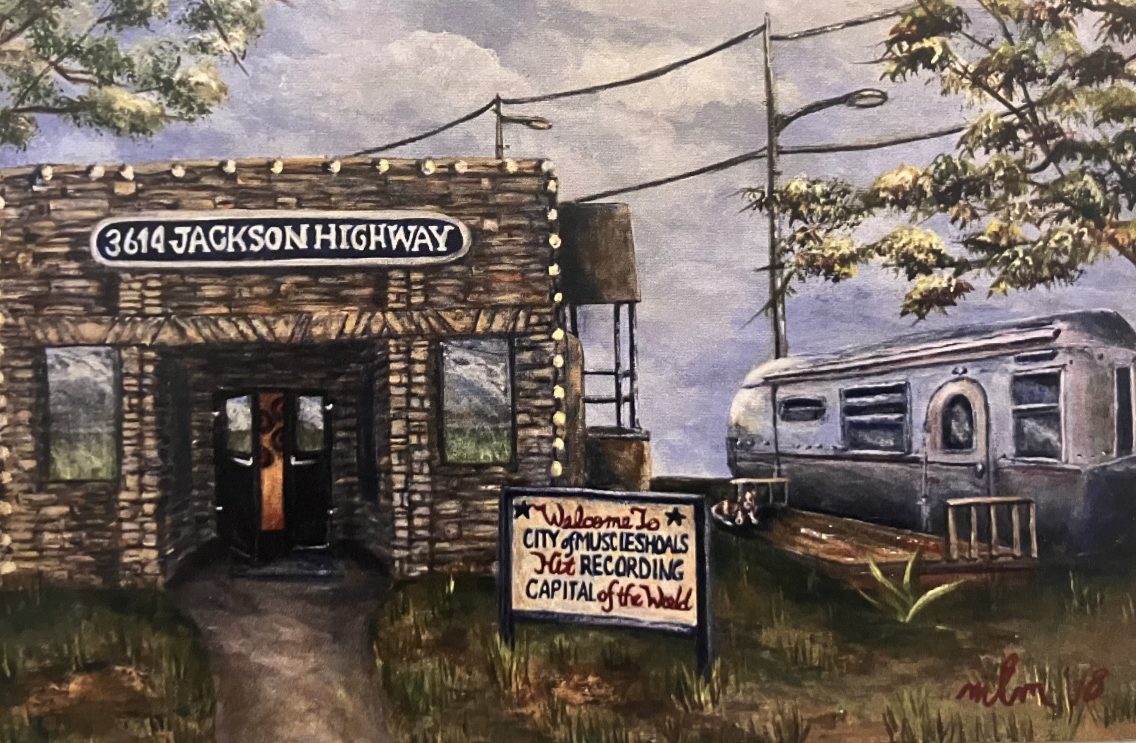
It is from these banks here, despite the displacement, the economic poverty, the federal programs, the power that brought in artificial light, that a sound also came up and filled the air with the soul that became known as the Muscle Shoals Sound.
“It’s like the songs come out of the mud,” said Bono of this place, in the 2013 documentary Muscle Shoals. “We felt the blood of that… and we wanted some.”
The sound here is it’s own, different from Memphis, St. Louis, Detroit, Chicago, New Orleans, New York, or LA.
And despite its place in American music history, today, the town seems a bit slow, and sleepy, in that hot summer Southern day way.
Its buildings are blighted, lawns are overgrown. Yet there is a dull wildness that blankets the quiet streets. Not the melancholy of Detroit, or the low rumble of Chicago, or the sanitized, disinfected bits of Memphis or Nashville, but rather a dull, suppressed excitement, that, instead of tornadoing up, has seeped back into the earth, with slow and low hum.
As we roll through town, a handful of tourists congregate for a tour of Muscle Shoals Sound Studio. Fame Records sits across town.
Our destination is the woman in the water.
We come to honor Nunnuhsae.
Under a clear blue sky, a rising sun, and grandmother moon’s watchful eye, a family fishes down stream. A barefoot man climbs around the rocky shoreline, hoisting and lowering his nets. A young man in all black–who looks exactly like a skinny squatter punk of 30 years ago–leans back upon his pack, and watches the water roll by.
No one is on their phone.
Birds fish and tease each other in pairs. A brown pelican soars alone, just above the water. Blue butterflies flutter.
The water laps along the shore.
Under the sun and moon, the alchemy of Nunnuhsae stirs the soul.
I’ve heard her, and you’ve heard her, too.
If you go to a quiet place, they say, you can hear Nunnuhsae too.
###